
Hagen thewoodchooper
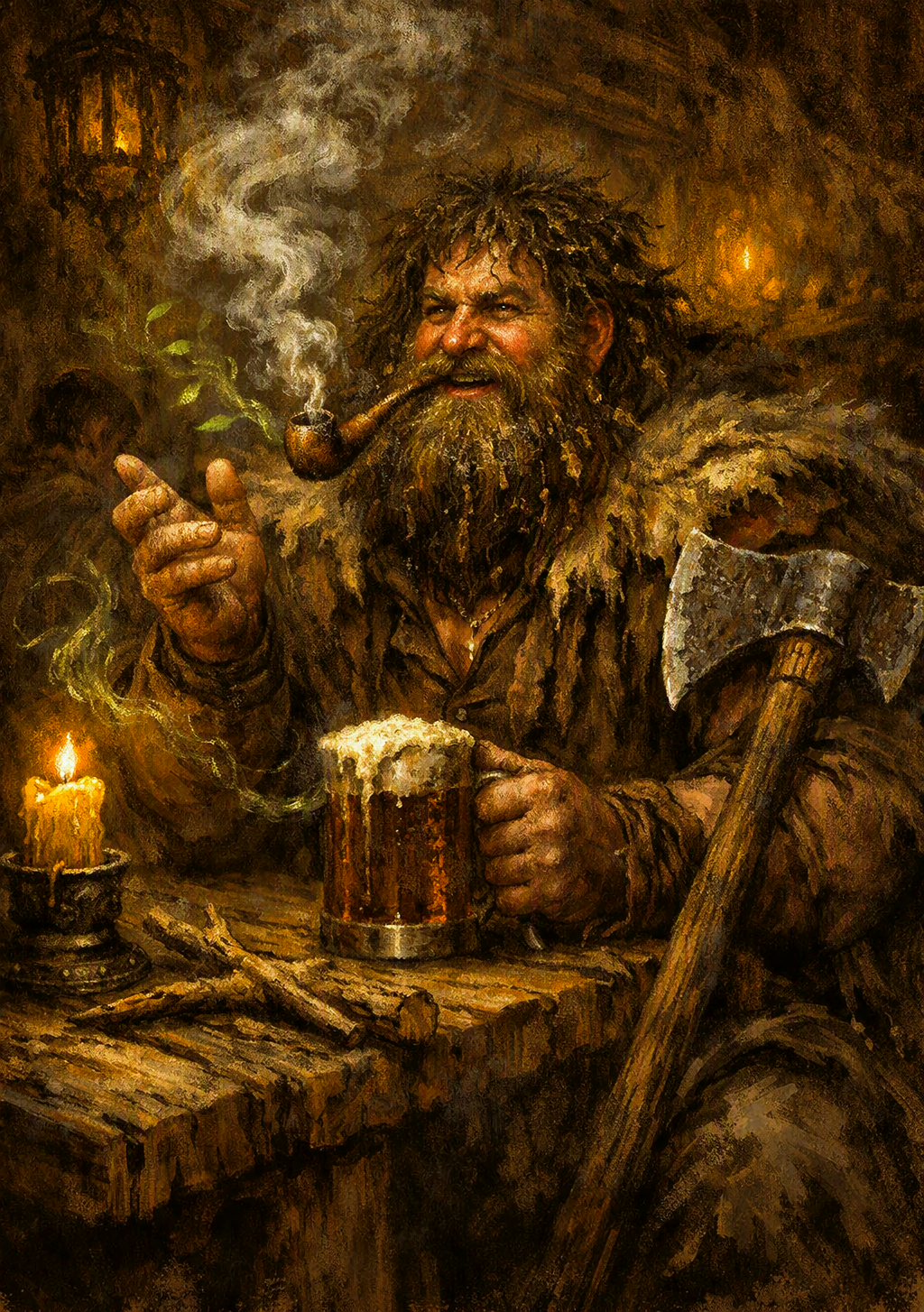
Hagen in his element.
Chickatuka
When Hagen the Woodchopper came out of the woods, he liked to head to Castletown. Once there, he would stomp into an inn and seat himself at a table. Then he would order ale, and sometimes herring or even a sea bass if he was particularly hungry, which he almost always was. Then he would cock an ear and listen for conversation about forests and trees and monsters of all sorts. Hagen had a keen sense for talk of things unnatural and uncommon. And it was not hard to catch fragments of conversation about a myriad of strange occurrences seen and heard by the local villagers. Indeed, every coastal village had a local sea monster that would haunt the local harbors and coastal waters. Every village had tales of serpents and werewolves and forest sprites and witches to boast of, and it was not uncommon for villages to relish the distinction, as the haunting of a dead wizard was something to be proud of. And it is true that the local inn keeper and tap-master knew them all, for his was the trade in such stories that kept men drinking and smoking pipes long into the dark and dismal night.
And Hagen had stories of his own to tell over a pint if the mood struck him. Hagen knew the trees, and the trees knew Hagen. Now it is true that the trees spoke to Hagen in their own way; it is also true that not all of the trees were equally fond of Hagen, and it is decidedly true that some of the trees even lied to Hagen and even tried to trick him for reasons of their own. Hagen was a queer fellow to be certain, but he was honest and he was fair. He loved the trees.
Hagen took his tankard in hand and roamed about the darkening room about which candles burned on mostly empty tables. The men all recognized Hagen, for they had heard of him, and many stories about him were spoken in dark corners late at night. Hagen, for his part, knew the names of trees, and had little time for the names of men.
“Tell us a story, Hagen,” said one of the men sitting in a haze of smoke near the window. “Tell us the news from the trees.”
“Much of the wisdom of the trees finds no place in the mind of men,” Hagen replied with a sneer and a long drink from his tankard. “The trees tell stories just as drunken men tell stories, but it is difficult to know the meaning, for the trees speak not in the tongues of men. The trees speak in the tongues of the wind, and to hear the wind, and to know the wind, is to discover secrets long hidden from the tongues of men.”
“How can you speak to the trees only to chop them down”
“The chopping of trees is my trade,” Hagen replied. ‘The chopping of trees is a noble trade, but a woodchopper must guide his axe from love, and not malice. I speak to the trees and tell them that I chop only of necessity. This is when they speak to me of secrets so that they may not have lived in vain.”
“What secrets can the trees know of the world of men?”
Hagen sat down noisily on the chair next to them. He was enormous in size, for his strength was known, and woodchips clung to his beard. “You can’t expect me to speak until I wash the sawdust from my throat,” he replied.
Soon one of the men set a large glass of ale before him. Hagen drained it with a single gulp.
“Now then,” he said. “The trees know about storms, and the trees know about wind and rain. The trees know about angels and things of the earth, spirits and other things from the Otherworld. I know this for the trees have told me many things. The trees know about the saints and the deeds of St. Patrick, for many of the trees I know were alive when Patrick drove the snakes off the island. The great hooded serpent Chickatuka was here when the ship of the saint arrived . . .”
Another glass of ale was set before Hagen and he drained it with a loud gulp, for he was thirsty from the telling of tales.
“The Saint scoured the island looking for Chickatuka, but the serpent could not be found. Patrick searched through the hills and through the rocky crags, but the snake proved too elusive. The saint appealed to the Lord, but still Chickatuka could not be discovered. One day Chickatuka appeared to the saint in the bough of a tree and spoke.
“Why do you drive all of my brethren off the island? Tell me, saint, why you do this thing?”
“You crawl on your belly like a serpent,” the saint replied. “Need I say more?” Then the saint raised his staff and held it aloft.
Chickatuka laughed. “I am not frightened of your staff, saint. I am older than your Lord. My belly is where I belong. Leave me in peace.
Patrick shook his staff. “Be gone, Satan.”
“I am not the Satan,” cried Chickatuka. “Long ago I was a man, just like you. Long ago I was a King in a very old and pagan land.”
“Why do you crawl upon the earth?”
“Your God put me here to learn a lesson, and that I should learn mercy from the heart of men. Yes, I was cruel as a King and I set forth terrible sentences upon my people, but I did not listen to the prophesies, and I did not know, so I have been condemned to learn. My hearing is acute, and at night I slither to the houses of the sleeping people . . . and I listen, for I can hear what is inside their heart.”
“Tell me,” Patrick asked, “what have you learned from the heart of men?”
“That I shall live forever,” Chickatuka replied.
Patrick prepared to go, but before he left, he said, “The heart of men is good, Chickatuka. You are not looking deeply enough.” And then he left the serpent and went away forever.
Hagen loved to tell stories. He would gauge the story he would tell based upon how may pints of ale would be required in the telling. Sometimes a tree would tell him a simple story, and it would require no wood chopping skill to tell it within the scope of a single pint, and Hagen had many one pint stories at his disposal.
Stories that contained a moral at the end were usually 2 or 3 pint stories, and he also had many such stories in his collection. The people liked these 3 pint stories if the drinking had not yet escalated, but once the drinking had escalated, it was not enough to charm them with a story about morals. Hagen had all these subtle details worked out after so many years, but in the past he had often chosen the wrong story at the wrong time, and sometimes it ended poorly.
On one such day, Hagen was speaking to a small crowd of Manxmen returned from the sea for the day with their well-earned hold. The men were tired and the men were thirsty as fishermen sometimes are.
“What news from the trees?” they asked upon seeing Hagen.
“The trees were tired,” Hagen replied. “Just like fishermen returned from the sea, they wanted water, but the sky would not open for them.”
Soon Hagen had several pints before him, and after guzzling two them in a single drought, he began his story:
“The trees are pretty quiet, most of the time. There is not much that they would share with people, for people are greedy, and people are violent and unpredictable. Mostly, they hate wood choppers however. But, though I am a chopper of trees, the trees hold no grudge against me, for they know that if not for me, the coming wood chopper could be cruel and uncaring, so they speak to me … and I listen, and I feel for the trees.
“My life as a wood chopper brings me into contact with many trees. I hew them when I must, and I take great pleasure in the hewing, for I am a hewer of trees. But often, I like to speak to them before I begin, and I often comfort them and that they may be useful in their time on this earth. Oh, that we could all be of some usefulness … that would be a wonder.”
The men were getting restless now. They were waiting for something of importance from Hagen. They were waiting for him to come to the crux of the story. An old grizzly man let fly with a vibrant fart, and there was much cheering. Hagen reached for his pint and thought carefully, which for a wood chopper is not much at all.
“I came to a perfect tree at last,” he continued. “This was the tree I decided to hew, for it would make a fine chair, or a nice sewing table. I looked it over for a long time before lifting my ax, for there is no honor in hewing a fine tree without reflection. The tree spoke to me during my reflection. The tree spoke from very far away, but I could distinguish its voice. Simply put, the tree wanted to know why I was about to hew it to smithereens. But what was I supposed to say? This had happened to me often, so I decided to just tell the tree the truth and hope that it would be comforted. “I must needs cut you down,” I said. “Your flesh is very important to me.”
“A wise magpie spoke to me and said that my perfection was the reason I would never be destroyed, for even the race of man would never willingly destroy such perfection.”
“You have been deceived by the magpie,” I said. “I hew what I must, the perfect as well as the imperfect alike.”
“Would you hew down a sacred tree just to disprove a magpie?”
Hagen had to contemplate this question. But first he had to scratch his beard, and after scratching and scratching until wood chips began to fall out, he needed a long drought of ale. Then he was ready to answer.
“You are not perfect,” Hagen admitted to the tree.
“I am a sacred tree,” the tree responded. “I am perfect, as are all sacred trees.”
“It is not for you to judge your own perfection,” Hagen said with authority.
“And it is not for you, a mere wood chopper, to know perfection. Are even sacred trees in danger these days?”
“You are beautiful, and yet I must chop you down,” Hagen replied sadly.
“If you do so, the trees will never speak with you again. I have great roots that reach down into the earth, and I have powerful branches for twitching and twittering, and I will tell them that you would not turn your ax to another tree, but that you could do with nothing but a sacred tree.”
“Alright,” Hagen relented. “I suppose I could do with a lesser tree, unless you would allow me to take just a few of your sacred branches.”
“Did you chop the entire tree down just for spite?” asked a young brash man.
“I would never do that,” Hagen replied before draining his pint. “The trees speak wisdom, and the trees speak the truth, for they have no purpose in lies and deceit. I took but a small branch from the sacred tree, and then we departed friends.”
“What is the purpose of such a story” one of the men complained.
“The question of the sacred nature of a sacred tree is unquestionable. The purpose of perfection is perfection.” Hagen replied.
Farts could be heard throughout the room. indicating that the men were unhappy. The men were hoping for more. They wanted Hagen to give them a moral to take away with them, something simple that they could understand. Instead, they were lost inside the ambiguities of Hagen’s words.
“Tell us another story, Hagen,” they demanded, before quickly putting four more pints before him.
Hagen hoisted one of the pints and drained it before setting it down again. “All right then,” he said. “I’ll tell you what the trees told me last night.”
The men quieted down. This is what they wanted. They wanted Hagen to tell them something strange, something that would make them ponder long into the night. If the trees knew something that they should know, then they needed to hear it from Hagen.
“I was up near Foxdale, following the Silverburn. There is a small copse of trees that I had been keeping an eye on for quite some time. I knew that there was a long history of strange and pagan rituals that happened there long ago before the saints came. I always suspected that there were spirits that were still there, waiting to rise again if only they were be summoned … so I went there on occasion to speak to the trees about it. I felt a presence … the presence of a whippoorwill, and I grew none to fond of this place.”
“What did the trees say, Hagen?”
“I was just coming to that part my lad,” and he suddenly snatched up another pint and guzzled it down without a second thought. “Now then, even the trees don’t like the presence of this place, but they have been unfortunate to have been born there. They have been carefully casting their seeds to the wind and to the birds in the hope that their predecessors will take to better soil away from this cursed place.
“Now the whippoorwill sit in those trees and chatter amongst themselves. But the trees don’t interfere, and the trees don’t care much for the whippoorwill. The trees can hear them speaking evil and plotting against man. It’s no secret that the whippoorwill wait near open windows for the moment of death so that they may steal the souls of men. And then they return to the trees to discuss it and to take satisfaction in their evil deed. They perch in the shady boughs of the trees and cackle, and their cackling only makes us listen even more carefully. They try to disguise their naughtiness cackling with a pretty, melodious song, but to the trees it is cackling, because we are aware of their sinister nature, even as the nature of man is aware of the nature of rats and other foul creatures.